UNHAS School of Public Health Hosts Guest Lecture on Food Innovation and “Waste to Wealth” with Malaysian Academics
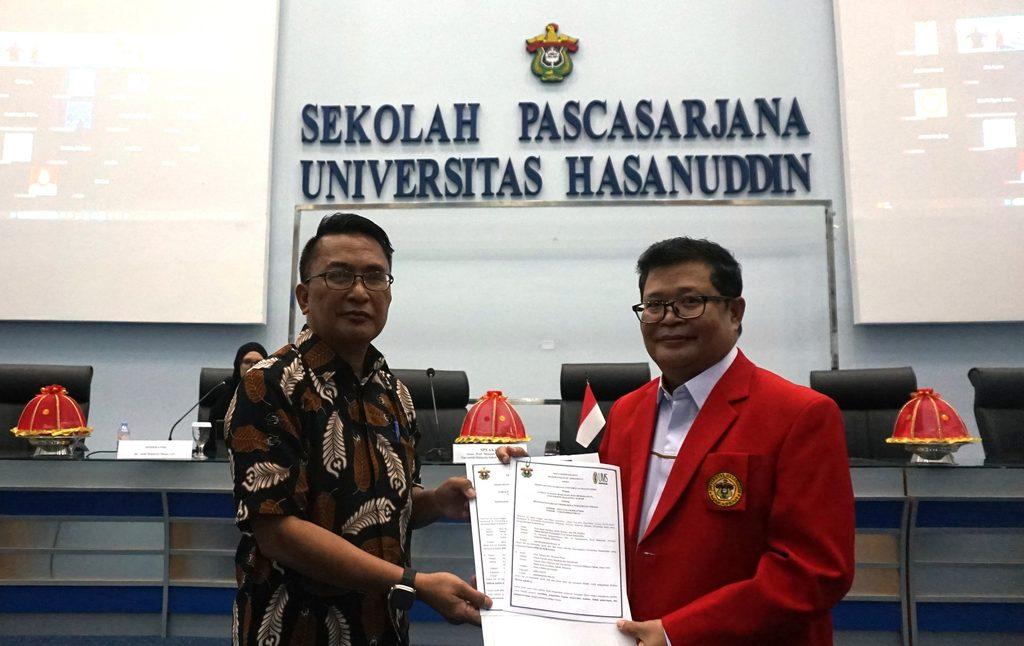
MAKASSAR — Featuring an academic and researcher from the Food Security Research Laboratory, Universiti Malaysia Sabah (UMS), Assoc. Prof. Dr. Mansoor Abdul Hamid, as the keynote speaker, the Graduate School of Universitas Hasanuddin (UNHAS) held a Guest Lecture entitled “Food Innovation from Underutilized Agriculture Materials: Food Security Solution Approach.”
The lecture discussed strategies for transforming agricultural waste into functional food products with high economic value. The hybrid academic forum was held on Tuesday, September 29, 2026, at 10:00 a.m. Central Indonesia Time (WITA) at the Prof. Dr. Ir. Fachruddin Hall, UNHAS Graduate School, and was also broadcast online via Zoom.
The event was officially opened with a welcome speech by the Vice Dean of the UNHAS Graduate School, Prof. Dr. dr. Marhaen Hardjo, M.Biomed., Ph.D., and moderated by Dr. Andi Muliarni Okasa, S.P.
In his opening remarks, Prof. Marhaen emphasized that the UNHAS Graduate School remains committed to facilitating academic discussions with international standards. He expressed hope that collaboration with researchers from Malaysia would create more opportunities for applied research among the academic community in addressing challenges related to food security and environmental management.
“We hope this event will provide valuable insights and encourage stronger collaboration between UNHAS and Universiti Malaysia Sabah (UMS),” said Prof. Marhaen.
During his presentation, Assoc. Prof. Dr. Mansoor Abdul Hamid explained that for local fruits such as jackfruit, bananas, and mangoes, people generally consume only the edible flesh, which accounts for around 20% to 30% of the fruit’s total weight. The remaining 70% to 80%, consisting mainly of peels and seeds, often ends up as waste.
“Through the Waste to Wealth approach, agricultural organic waste can be processed into safe and affordable food ingredients that are rich in functional compounds such as antioxidants, dietary fiber, and protein,” explained Dr. Mansoor.
At the end of his presentation, Dr. Mansoor highlighted that food innovation based on local materials can provide benefits across multiple sectors. In addition to strengthening national food security by increasing the availability of nutritious food, the utilization of agricultural by-products can also create additional economic value for farmers and food industry businesses while helping reduce environmental pollution caused by organic waste.
The organization of this guest lecture once again demonstrates the commitment of the UNHAS Graduate School to promoting sustainable synergy between scientific development, community economic improvement, and environmental conservation.