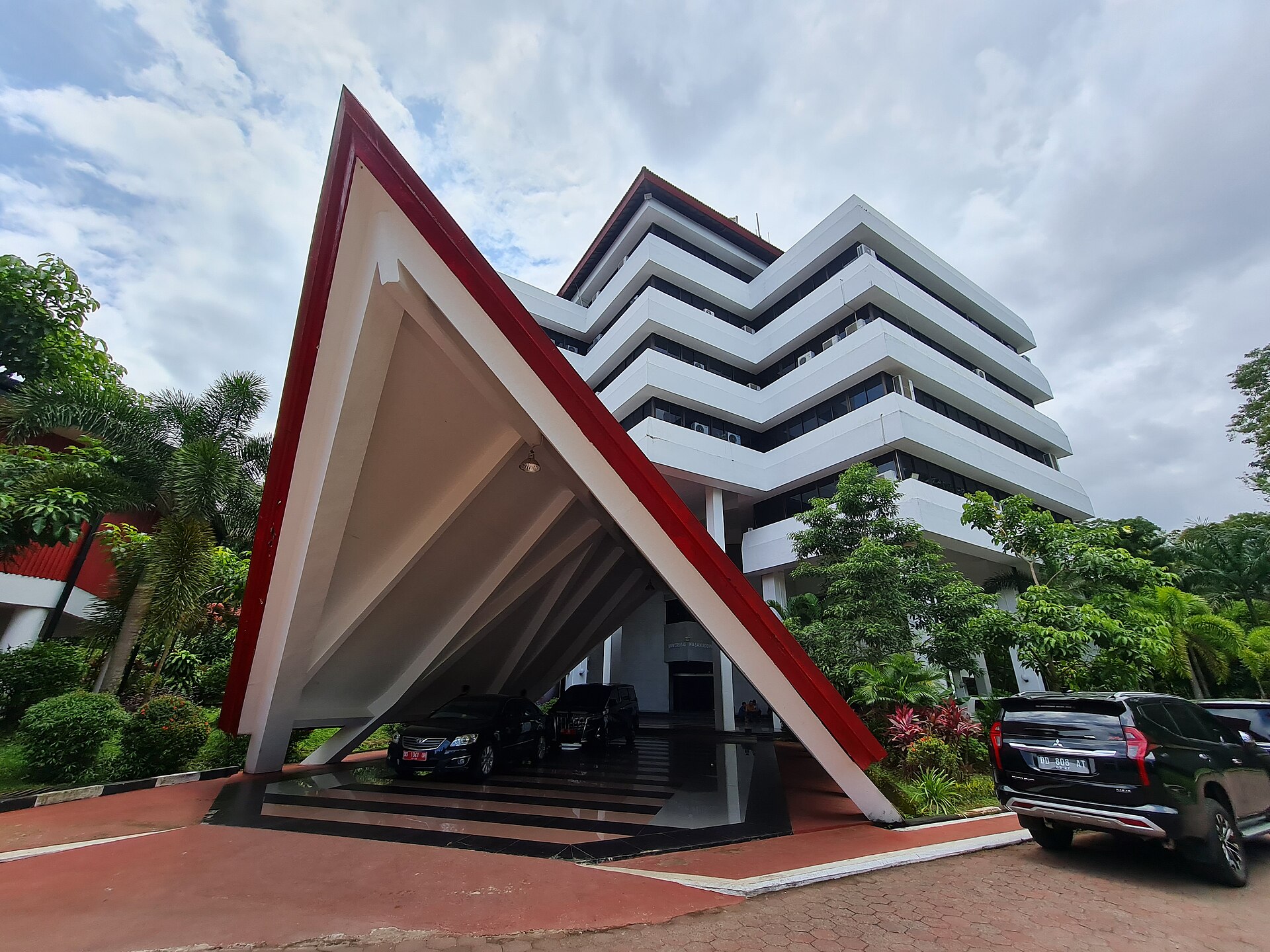
Rectorate Building of Universitas Hasanuddin. Photo: MesinKetik / Wikimedia Commons, CC BY-SA 4.0
Universitas Hasanuddin, the parent institution of graduate education at Unhas, was inaugurated on 10 September 1956 by Indonesia's Vice President Drs. Moh. Hatta. Graduate education began to take shape 24 years later, in 1980, when Rector Prof. Dr. A. Amiruddin formed the Graduate Education Preparatory Committee chaired by Prof. Dr. Ir. Fachrudin.
The committee was tasked with preparing the opening of Master's (S2) education to meet the need for university lecturers as well as regional and national development. From that first step, graduate education at Unhas grew into a Graduate Faculty, then a Graduate Program, and today the Graduate School.
Universitas Hasanuddin Inaugurated
Universitas Hasanuddin was inaugurated by Indonesia's Vice President Drs. Moh. Hatta, becoming the parent institution of graduate education at Unhas.
Graduate Education Preparatory Committee
Unhas Rector Prof. Dr. A. Amiruddin formed the Graduate Education Preparatory Committee, chaired by Prof. Dr. Ir. Fachrudin, to prepare the opening of Master's (S2) education.
Graduate Education Opens
Through Decree of the Director General of Higher Education No. 325/D/T/1982, Unhas was entrusted to open graduate education in partnership with Institut Pertanian Bogor (IPB) under the Credit Earning Activities (KPK) program. The first four study programs were Agricultural Systems, Regional Planning and Development, Environmental Management, and Resource Economics. Leadership: Prof. Dr. Ir. Fachrudin, with Dr. Sjamsuddin Rasjid, M.Sc. as secretary.
Becoming the Graduate Faculty
Under Presidential Decree No. 52 of 1986, graduate education at Unhas was recognized as the Graduate Faculty, inaugurated by the Minister of Education and Culture Prof. Dr. Fuad Hassan on 9 December 1986. At the same time, a partnership with IPB was signed for a Doctoral (S3) program in the agricultural sciences. Leadership passed to Dean Prof. dr. Hardjoeno, as Prof. Dr. Ir. Fachrudin was appointed Rector of Unhas. During this period the Graduate Faculty produced its first 5 Master's graduates.
Back to a Graduate Program
Following the National Education System Law and Government Regulation No. 30 of 1990, Decree of the Minister of Education and Culture No. 0311/O/1991 changed the Graduate Faculty back into a Graduate Program at all state universities and institutes, including Unhas. Prof. dr. Hardjoeno continued to lead.
Leadership of Prof. Sumali Wiryowidagdo
Prof. Dr. Sumali Wiryowidagdo led the Graduate Program, assisted by dr. A. Husni Tanra, Ph.D. and Dr. Syahruddin Kadir, M.Sc.
Leadership of Prof. A. Husni Tanra
Prof. dr. A. Husni Tanra, Ph.D. became Director of the Graduate Program, supported by assistant directors for academic affairs and research, administration and finance, and partnerships and development.
Leadership of Prof. M. Natsir Nessa
Prof. Dr. Ir. M. Natsir Nessa, MS served as Director of the Graduate Program, assisted by Prof. Dr. Sumarwati Kramadibrata Poli, M.Lit. (Assistant Director I) and Prof. Dr. Aminuddin Salle, SH, MH (Assistant Director II).
The Graduate School Era
As the Graduate School, the institution was led by Dean Prof. Dr. Ir. Jamaluddin Jompa, M.Sc., who was later elected Rector of Universitas Hasanuddin.
The Graduate School Today
The Graduate School of Unhas is led by Dean Prof. Sukri Palutturi, SKM., M.Kes., M.Sc.PH., Ph.D., with the vision of becoming a center for human, scientific, technological, and artistic development based on the Indonesian Maritime Continent.
Two decades after it began, graduate education at Unhas had produced 275 Doctors, 7,370 Master's graduates, and 804 Medical Specialists, offering 32 Master's (S2) and 8 Doctoral (S3) study programs. This growth was driven by the increasing number of Unhas lecturers returning from studies in Indonesia and abroad, and by strong public demand for further education.
Partnerships were also established with institutions abroad, including Virginia Commonwealth University, Cornell University, and the University of Cincinnati (USA), The British Council and the University of Manchester (UK), the Technical University of Berlin (Germany), the University of Guelph (Canada), the Regional English Language Centre (Singapore), and the University of Newcastle (Australia), through lecturer exchanges, sandwich programs, and scholarships.
Today the Graduate School of Universitas Hasanuddin has produced more than 25,000 Master's graduates and 2,300 Doctors, and continues to grow as a center of graduate education and research in eastern Indonesia.
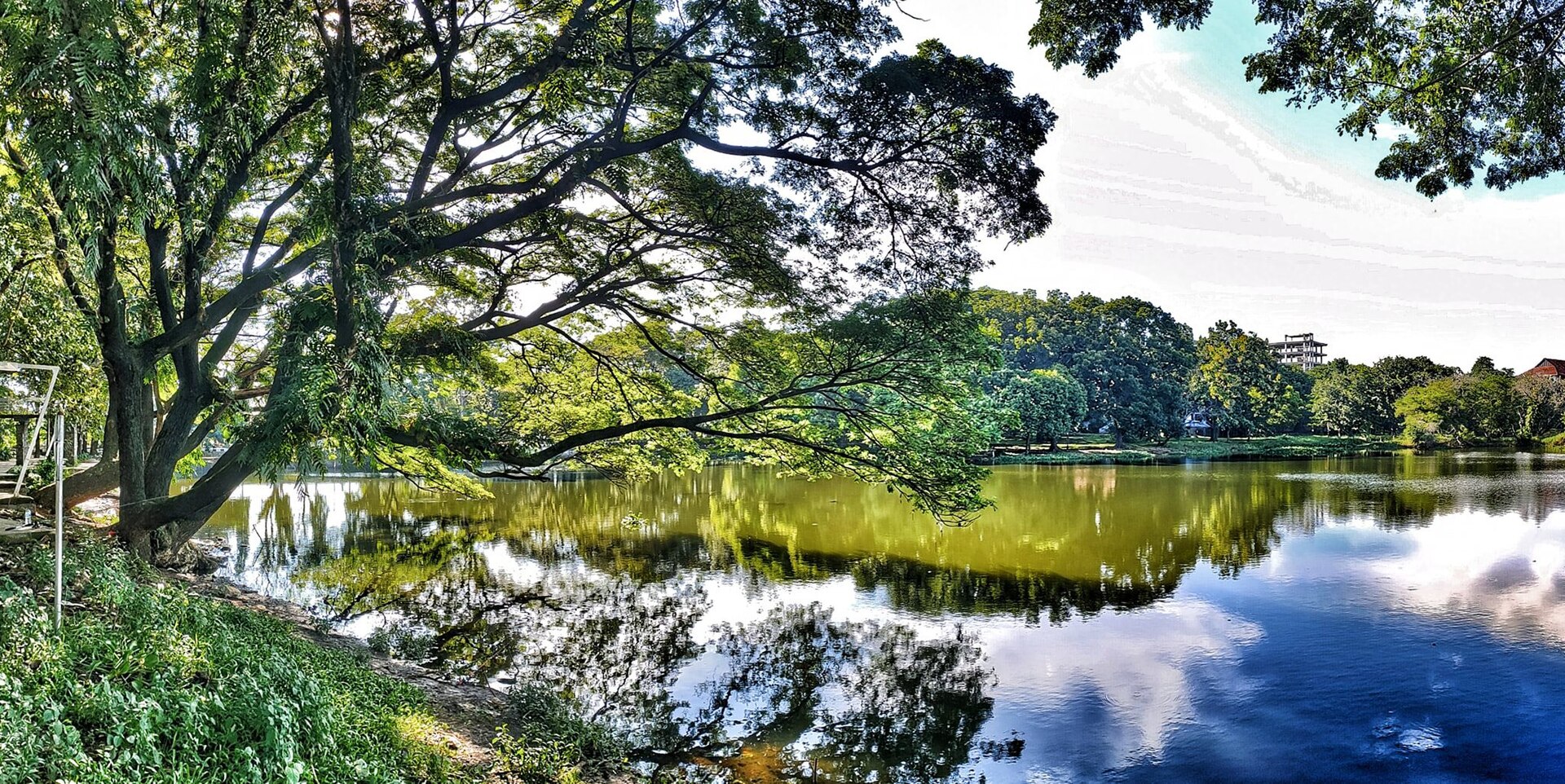
Unhas Tamalanrea campus lake. Photo: Imingphotography / Wikimedia Commons, CC BY-SA 4.0