Through the “Diaspora Berdampak” Initiative, UNHAS’s School of Public Policy Demonstrates Its Commitment to Accelerating the Sustainable Development Goals (SDGs)
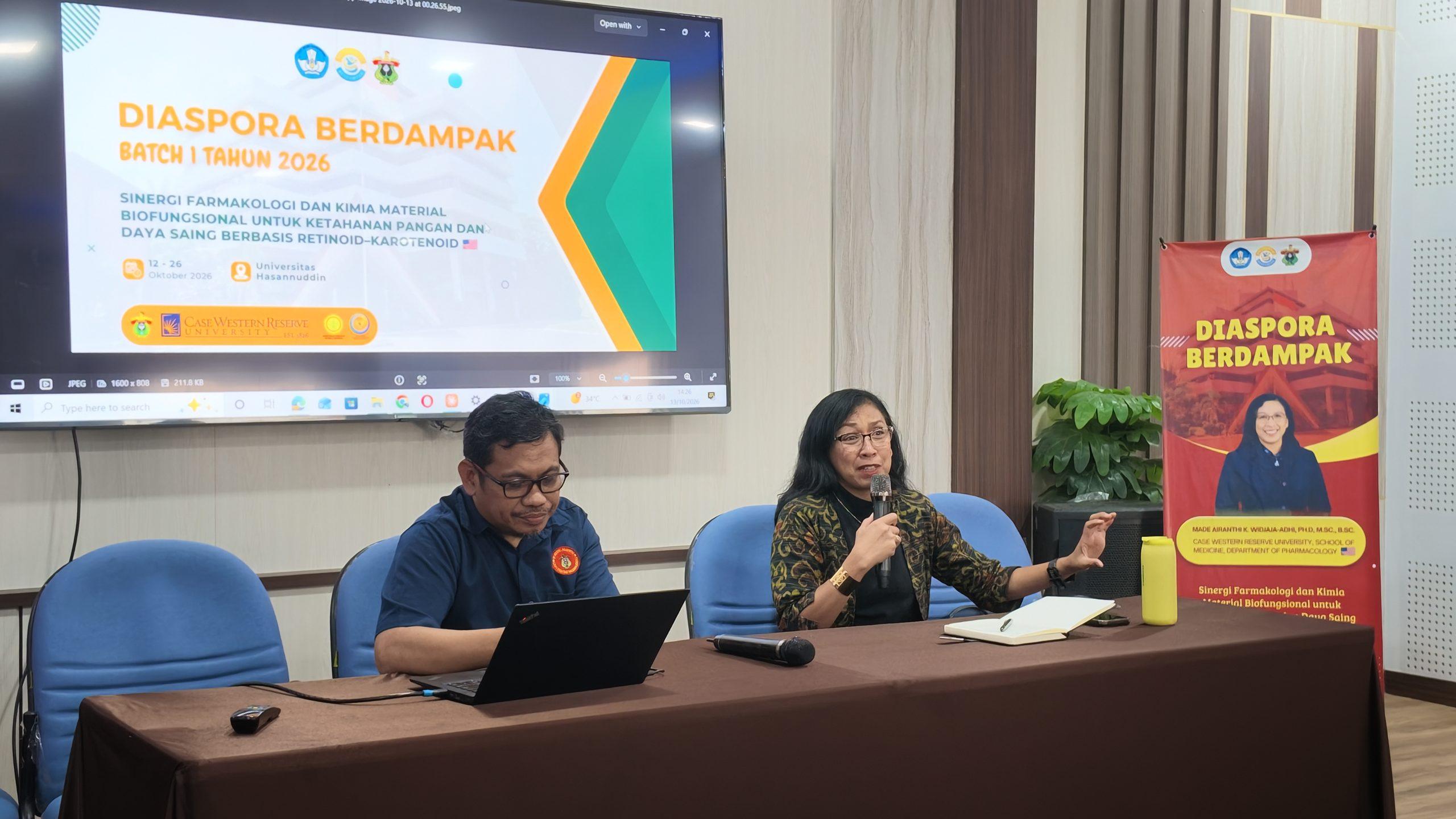
MAKASSAR — The Graduate School of Hasanuddin University (SPs UNHAS) has once again expanded its international research network by organizing the "Diaspora Berdampak" Batch 1 Program for 2026. Held at the SPs UNHAS Smart Class on Tuesday (Oct. 13, 2026), this academic forum featured Made Arianti K. Widjaja Adhi, Ph.D., a faculty member from the Department of Pharmacology, School of Medicine, Case Western Reserve University, USA, to examine the potential of biofunctional research in addressing public health challenges in Indonesia.
Interestingly, the discussion did not stop at mere pharmacological theories. The interactive session instead evolved into a cross-disciplinary dialogue space connecting advanced science with real issues in society.
One of the highlights emerged when Dr. Sherly Wulandari, S.K.M., MPH., pitched an idea regarding opportunities to develop her doctoral research in environmental health. This question opened up a new perspective on how environmental research can be re-examined through the lens of material chemistry and pharmacology to produce more comprehensive solutions.
The discussion delved deeper when Dr. Halisah, S.S.T., M.Keb. raised a crucial issue regarding regional stunting prevention. Responding to this, Made Arianti emphasized that the sophistication of scientific research must be balanced with direct education to the community at the grassroots level.
"The main problem in Indonesia often stems from education. It is very important to empower the community with insights, and it is us as academics who must go directly to provide guidance," stressed Made Arianti.
Furthermore, Made Arianti highlighted the close correlation between stunting interventions and household financial management habits. She cited a phenomenon in some fishing communities, where income increases during abundant fish harvesting seasons are often not balanced with adequate allocation for family nutritional spending.
According to her, the main challenge lies in prioritizing expenditures. Family economic improvements do not automatically improve children's nutritional status unless accompanied by an understanding of the importance of fulfilling primary food needs. This discussion broadened the participants' insight that addressing public health crises requires a holistic approach—combining nutritional science, behavioral education, and family financial literacy.
The participants' enthusiasm in connecting academic research with field dynamics proved the importance of multidisciplinary discussion forums. Through the Diaspora Berdampak program, SPs UNHAS not only facilitates knowledge transfer from world-class scientists, but also ensures that every international research discussed remains sensitive and rooted in local problem-solving solutions.
The implementation of the Diaspora Berdampak program also reaffirms SPs UNHAS's tangible commitment to supporting the acceleration of the Sustainable Development Goals (SDGs). This initiative contributes directly to SDG 3 (Good Health and Well-being) through food science research and stunting management, SDG 4 (Quality Education) through science-based community education strengthening, and SDG 17 (Partnerships for the Goals) through an international academic collaboration network with Case Western Reserve University, United States.