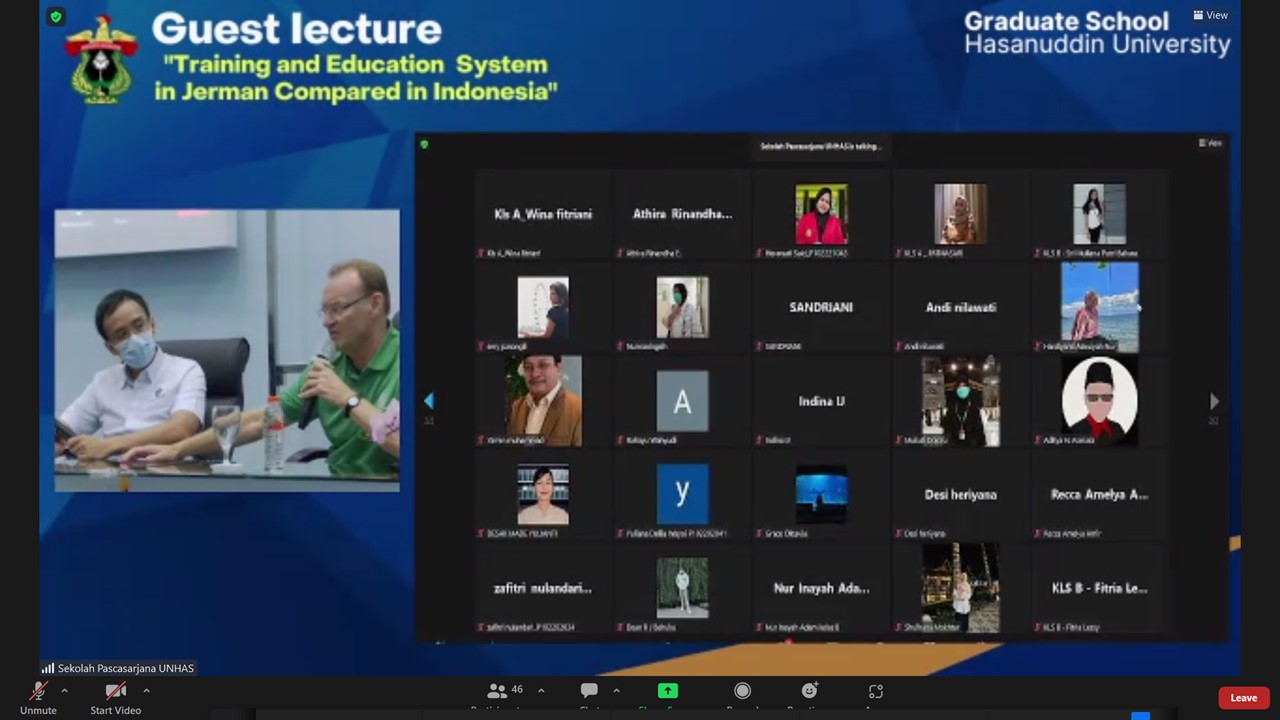
Graduate School Holds a Guest Lecturer Public Lecture on "Training and Education Systems in Germany Compared to Indonesia"
A public lecture themed “Training and Education Systems in Germany Compared to Indonesia” was held in hybrid format (offline and online) on Monday, 15 November 2022, from 09:00 WITA until completion, at the Prof. Dr. Ir. Fachrudin Hall, Graduate School of Unhas, to discuss the education system for becoming a healthcare professional in German hospitals, presented by Dr.rer.biol.hum. Lutz Vogel (Chief Pharmacist, Central Pharmacy for the District Hospital of Esslingen, President of the Union Hospital Pharmacists in Germany).
The event was opened by the Dean of the Unhas Graduate School, Prof. dr. Budu, Ph.D., Sp. M.,(K).,M.Med.Ed, and moderated by Muhammad Akbar Walenna, S.T., M.Sc., Ph.D.
The guest lecturer, referred to as Lutz, then held a question-and-answer session with the audience, explaining that to qualify as a healthcare professional in Germany, one must first pass an examination and complete one year of practical training, with most students completing their healthcare education over a period of five years.
Midwifery education in Germany is provided through dedicated midwifery schools and does not require prior graduation from a nursing school; however, students must undergo more than three years of practical training and, upon completion, receive a diploma similar to that of a medical doctor, Lutz explained.
In response to further questions from the audience, Lutz stated that “midwives in Germany practice directly in hospitals, the same as in Indonesia.” Midwives in Germany are covered by insurance, including transportation to and from the hospital, and their numbers have continued to increase year by year.
Lutz further explained, regarding the competency examination requirement for D3 (associate degree) graduates in Indonesia, that in Germany, nursing students who complete their education do not need a separate declaration of a nursing diploma, as the German education system does not have a Bachelor's or Master's level for this track. After completing nursing school, students can continue their education, for example, by pursuing a Master's degree in administration. However, the standard nursing school track does not require university entry; university entry requires completion of secondary school, and if repeating the entrance requirement, applicants must demonstrate proficiency in two foreign languages to enter university, where Bachelor's and Master's programs are available.
For complete information on the material presented by Dr. rer.biol.hum. Lutz Vogel, please visit the YouTube channel of the Graduate School of Universitas Hasanuddin at the following link